

Los Angeles County is most often associated with Hollywood, the sprawling metropolis of Los Angeles itself, the beaches of Santa Monica, and world-famous enclaves like Beverly Hills and Malibu. Yet beyond the film industry and city hall lies another layer of government that directly shapes the lives of nearly ten million people: the Los Angeles County Board of Supervisors. This governing body oversees an empire encompassing 88 incorporated cities, vast unincorporated areas, and a massive network of social, healthcare, law enforcement, and infrastructure services. Remarkably, the board consists of just five people. Each supervisor represents roughly two million residents. Read more on layes.
What Is Los Angeles County, and Who Governs It?
First and foremost, it is essential to distinguish between the City of Los Angeles and the County of Los Angeles. They are not the same thing. The City of Los Angeles is run by a mayor and a city council. Los Angeles County, by contrast, is a vastly larger administrative entity that includes dozens of other municipalities alongside extensive unincorporated communities.
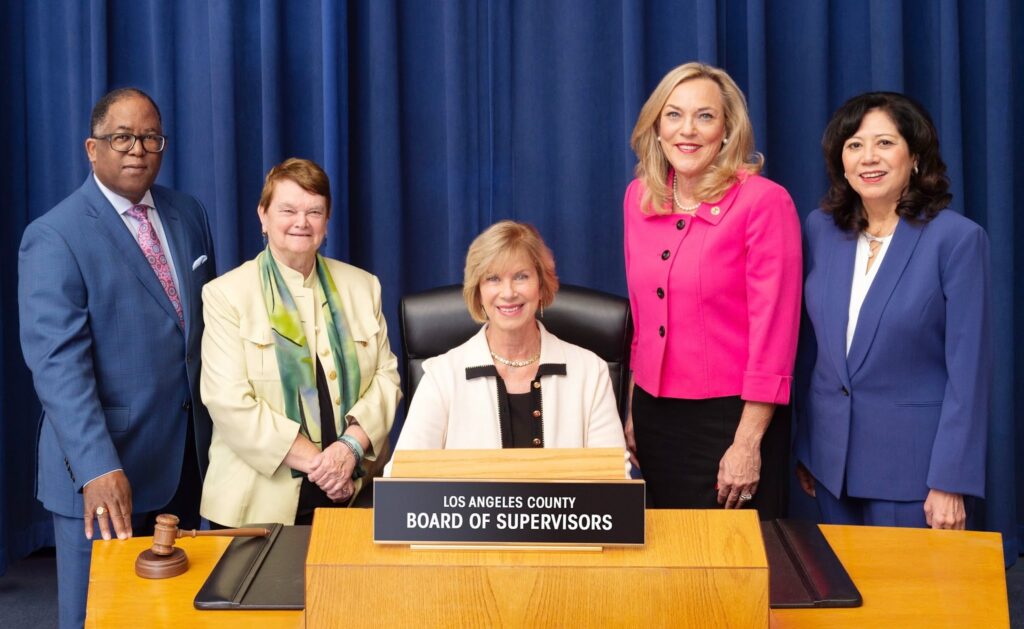
The county’s primary governing body is the Los Angeles County Board of Supervisors. Officially, the five-member board holds executive, legislative, and quasi-judicial powers. Supervisors are elected by voters in their respective districts and are limited to serving no more than three consecutive four-year terms. The board’s authority reaches into nearly every facet of daily life, including social services, public health, law enforcement, public works, infrastructure, county budgeting, department oversight, and the stewardship of public funds.
While California’s judicial branch operates independently and the county courts belong to the state court system, the county funds and maintains a substantial share of the administrative and operational infrastructure supporting the justice system. The Board of Supervisors also exercises significant budgetary and administrative authority over county departments. California law explicitly empowers the board to oversee county officials and set budget allocations, including those for the district attorney and the sheriff. At the same time, state law strictly prohibits the board from interfering with the independent investigative duties of either official.
Five People Representing Nearly 10 Million Residents
It is the sheer scale of the county that makes its governing structure so unusual. According to official county records, Los Angeles County serves more than 9.7 million residents with an annual budget topping $50.3 billion in 2026. Yet decisions across this massive jurisdiction still rest in the hands of just five supervisors. Official district data highlights just how populous each supervisorial district is:
- First District — 1,982,511 residents;
- Second District — 2,023,783 residents;
- Third District — 2,061,345 residents;
- Fourth District — 2,083,832 residents;
- Fifth District — 1,896,455 residents.
The history of this system dates back to the 19th century. On April 1, 1850, county residents elected their first governing body—a three-member Court of Sessions—with only 377 voters casting ballots. In 1852, the California State Legislature abolished the Court of Sessions and established a five-member Board of Supervisors. The real challenge arose much later. Over subsequent decades, Los Angeles’s population exploded, but the size of the board remained unchanged. Five seats designed for a 19th-century frontier county carried over into the 20th and 21st centuries. As a result, each supervisor came to represent a massive constituency. This extraordinary concentration of power is what earned them the nickname “the five little kings.” While their power is not legally absolute—it is checked by the U.S. Constitution, California state law, the county charter, and court rulings—their political clout remains exceptionally concentrated.

Why Is Their Power So Extensive?
The primary reason is not just the small number of supervisors, but the governing model itself. The board adopts the county budget and makes decisions that steer dozens of vital departments, including Public Health, Health Services, Public Social Services, Public Works, the Sheriff’s Department, Fire Department, District Attorney, Public Defender, Probation, and Mental Health. Consequently, the votes of these five individuals do not deal with abstract politics; they determine real-world outcomes, from funding hospitals and social programs to financing public works and public safety operations.
The California Government Code also explicitly grants the board supervisory oversight over county officials and budgetary authority over core agencies. That is why the Board of Supervisors exerts far greater real-world influence across the region than most people realize when looking solely at Los Angeles City Hall.
How Board Meetings Work
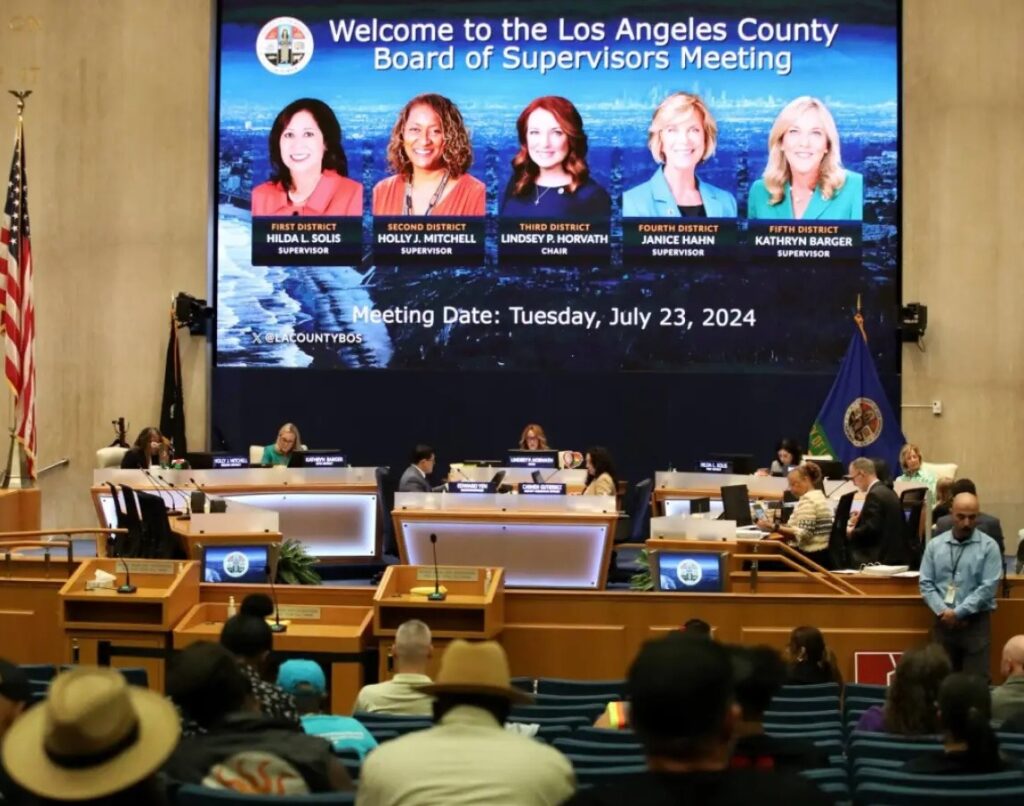
The board convenes regular public meetings to address county affairs and policy matters. A key fixture of these meetings is the consent calendar—a procedure allowing a bundle of routine items to be passed without debate, provided no supervisor or member of the public requests that a specific matter be pulled for individual discussion.
Meetings are held in accordance with the California Brown Act, the state’s open-government law. Agendas are posted in advance, and residents have the right to address the board during public comment. This serves as a critical check on power, ensuring that even this influential body cannot operate entirely behind closed doors.
Reforming the System
Efforts to reform the Los Angeles County Board of Supervisors span decades. Ballot proposals to expand the board were put before voters in 1962, 1976, 1992, and 2000, but voters rejected every single one. That changed in 2024. On November 5, 2024, county voters approved Measure G, the Los Angeles County Government Structure, Ethics and Accountability Charter Amendment. County officials described the measure as a historic overhaul of the local government structure. Rather than simply adding more seats, the reform creates a modern system of checks and balances that critics had demanded for generations.
A cornerstone of Measure G is expanding the Board of Supervisors from five to nine members. This change will be phased in over time: by 2031, nine new supervisorial districts will be established. The first seven supervisors under the new configuration will be elected in 2032, with the remaining seats filled in subsequent election cycles until the full nine-member board is complete. In doing so, the “five little kings” will give way to nine representatives serving more compact districts, while executive authority will transfer to an independently elected County Executive. For one of the largest counties in the United States, this marks the most consequential governance shift in generations.
The history of the Board of Supervisors demonstrates how long political structures built for an entirely different era can endure. Today, the debate is no longer just about who runs Los Angeles County—it is about how power itself will be balanced and exercised once this historic transformation is complete.