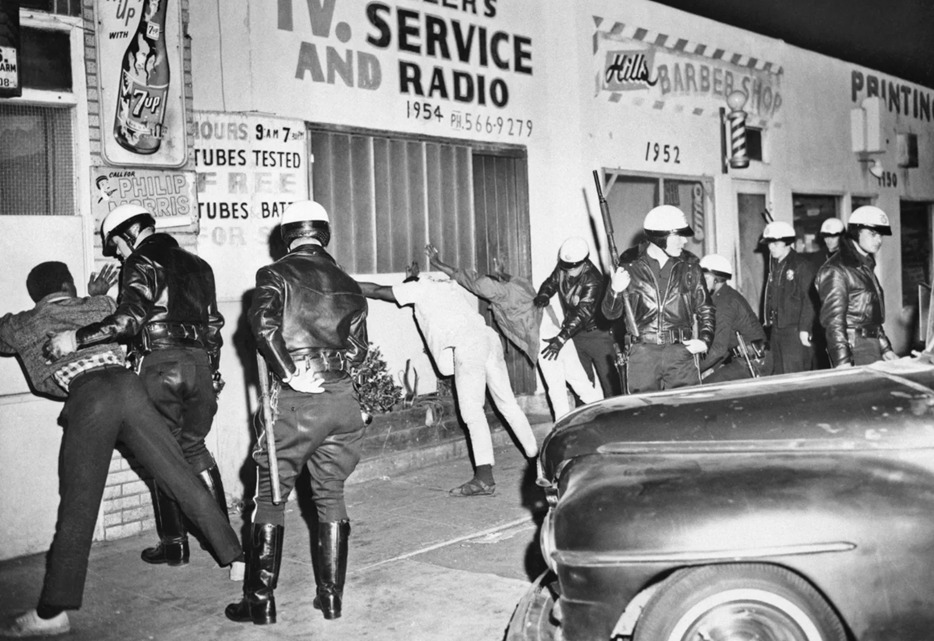

This is a dark chapter in Los Angeles history. It’s the story of a series of riots that erupted on August 11, 1965, primarily in the African American neighborhood of Watts. This rebellion—often called the Watts Riots—lasted for six days, leaving 34 people dead, 1,032 injured, and 4,000 arrested. For a deeper look into these events, visit layes.info.
How It All Started
Events of this magnitude don’t happen in a vacuum—there are always underlying causes. The flashpoint came on a Wednesday evening when two brothers, Marquette and Ronald Frye, were pulled over by a California Highway Patrol (CHP) officer near Avalon Boulevard and 116th Street in Watts. Marquette failed a sobriety test and was arrested, but the thought of going to jail frightened the young man. A scuffle broke out between Marquette and one of the officers, and Ronald joined in to defend his brother.
The incident quickly drew a crowd of onlookers. The CHP officers, perceiving the crowd to be hostile, called for backup. This led to another fight, this time between a bystander and an officer.
Marquette was eventually clubbed, handcuffed, and led to a police car. That’s when his and Ronald’s mother, Rena Frye, arrived and rushed to pull the officers away from her son. This sparked a new confrontation, and Rena was forcibly arrested and put in the car, followed by Ronald.
Public Outrage
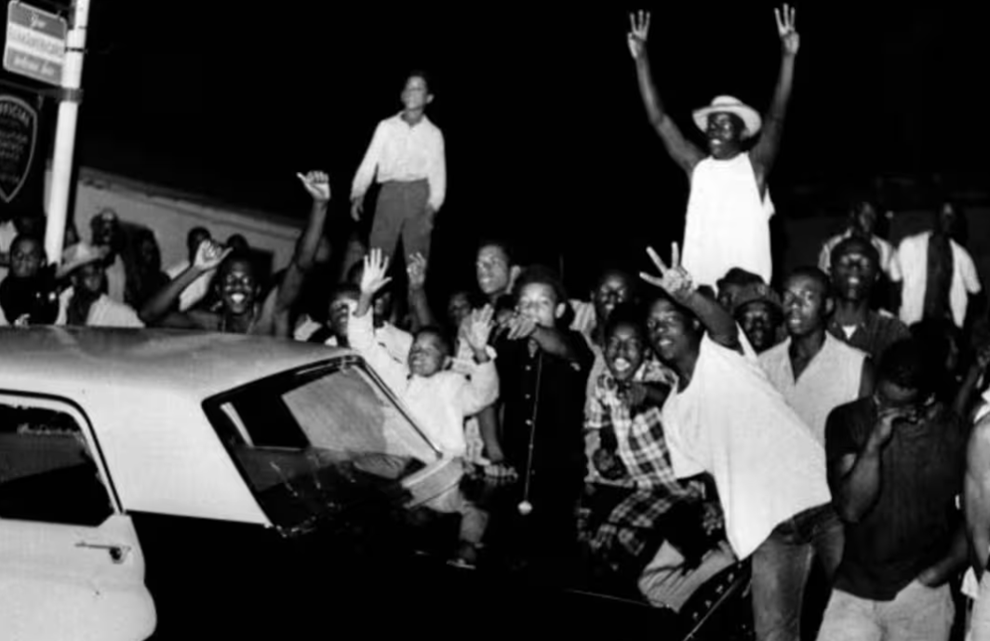
The crowd watched everything unfold, and their anger at law enforcement and the system escalated. The CHP officers used their shotguns and batons to push the crowd back from the patrol car.
As two officers tried to get on their motorcycles, one was spat on. They stopped and chased the woman they suspected of doing it, Joyce Ann Gaines, and arrested her. She resisted, and there were suspicions that she was pregnant. All of this further enraged the growing crowd.
By 7:45 PM, the riot was in full swing. Emotions were at their peak. The mob began to throw rocks, bottles, and other objects at buses and cars caught in the traffic jam caused by the unrest.
Rage in the Streets
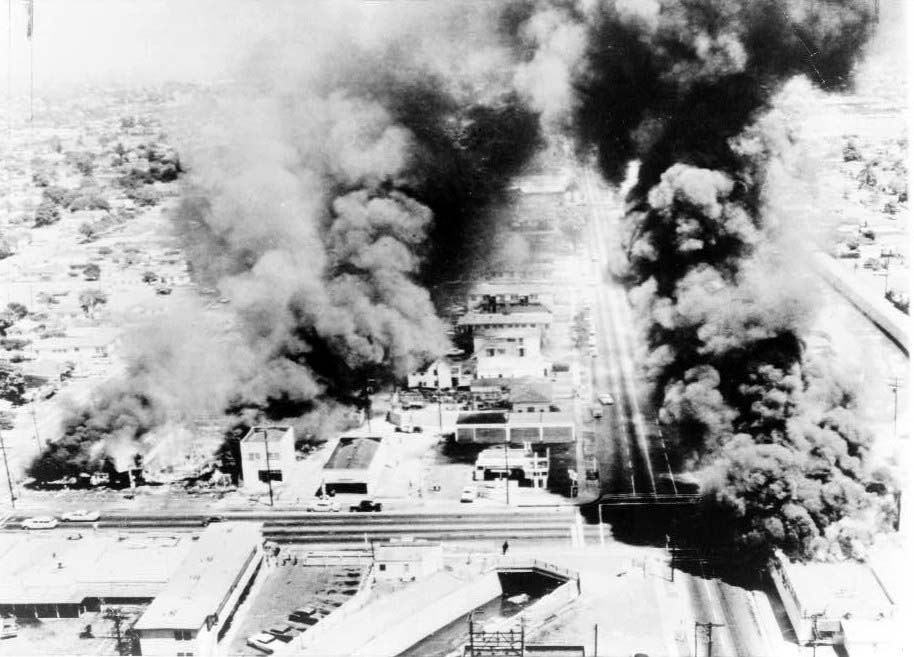
The day after the infamous arrests of Marquette, Ronald, and their mother Rena, the mob began attacking motorists with rocks and bricks, and brawls broke out.
Something had to be done. Community meetings were organized by local Watts leaders. Church representatives, local officials, and members of the NAACP (National Association for the Advancement of Colored People) attended these gatherings alongside police officers. The main goal was to calm the crowd. Rena Frye was there and asked people from the Watts neighborhood to settle down.
The next morning, Rena, Marquette, and Ronald were released on bail. The incident should have ended there, but the number of complaints against police and government treatment of African American citizens was immense. Patience had worn thin, and the arrests were the final straw. After the community meeting, a teenager grabbed the microphone from Rena and called for the riots to spread into the “white” neighborhoods of Los Angeles. For a better understanding of the atmosphere of the time, check out this history of the 1968 East Los Angeles school strikes.
Watts: A War Zone
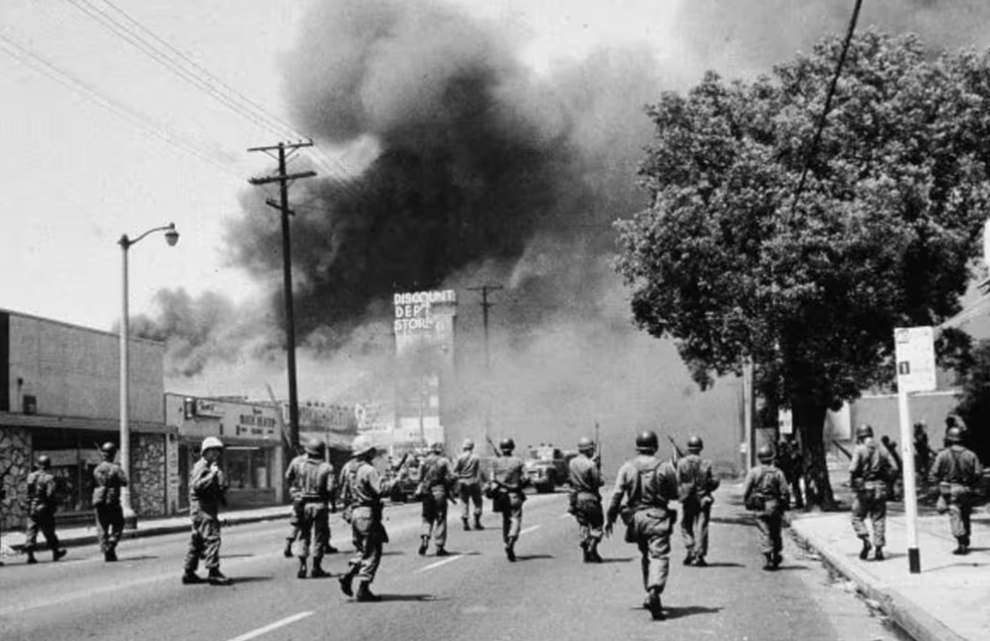
Watts was a district with a significant African American population. After the planned riots were announced, William Parker, the Chief of the Los Angeles Police Department, was also determined to take a firm stand. Local leaders suggested and even begged him to send more African American officers to the area, but he refused. Parker was ready to call in the National Guard.
Violence engulfed the city streets. Buildings and cars were set on fire, and local shops were looted. Crowds attacked firefighters, preventing them from putting out the blazes. On the third day of the riots, the Watts district of Los Angeles was declared a war zone, as 14,000 National Guard troops were deployed to the city.
There were barricades, sniper fire against police and guardsmen, police raids, and Molotov cocktails. These terrible events lasted for three more days.
LAPD Chief William Parker’s words and actions only further infuriated the protesters. He openly mocked the rioters, calling them “monkeys in a zoo.” He also hinted that Muslims were inciting the unrest.
On the morning of the last day of the riots, police surrounded a mosque, which led to a shootout and mass arrests. Law enforcement officers searched a neighboring building, using tear gas. These actions led to two fires that completely destroyed the mosque.
Approximately 34,000 people took part in the rebellion. The riots destroyed 1,000 buildings, and the damage was estimated at $40 million.
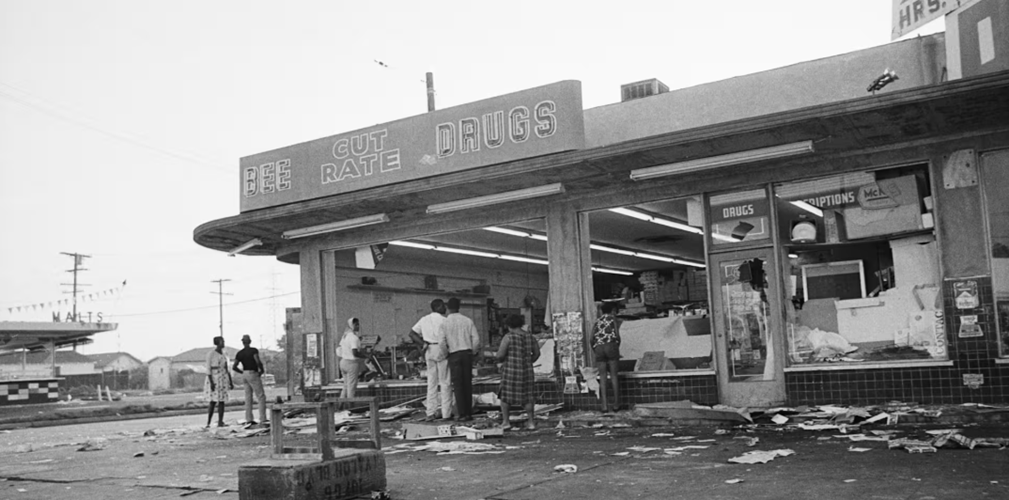
The Aftermath
The Watts rebellion left 34 people dead, most of them African American. Two police officers and one firefighter also lost their lives. The actions of the LAPD and National Guard accounted for 26 of the deaths, which were deemed “justified killings.” These events prompted the creation of a commission to investigate the causes of the riots, led by John McCone. The commission identified systemic issues—unemployment, housing, and education—as the root causes of the rebellion.
A new era of local activism blossomed in the Watts neighborhood. For example, members of reformed street gangs joined the Black Panther Party. Together, they sought to monitor police misconduct. The Watts Riots also spurred local initiatives not only to solve these problems but also to increase the visibility and representation of African Americans in various cultural spheres.
Los Angeles wasn’t the only city experiencing such unrest; riots were happening all over the country. In 1964, a three-day riot in Rochester, New York, left four people dead. In Harlem and Bedford-Stuyvesant, the shooting of a young African American man led to a six-day riot involving about 4,000 people. Similar incidents occurred in Philadelphia and Chicago.
What did they all have in common? They were all rebellions against long-standing grievances, and a revolt against police who often exceeded their authority. The riots became a powerful reaction against a system of injustice, police brutality, racial discrimination, and socioeconomic inequality. These uprisings exposed problems that had been suppressed for years. They brought to light the daily struggles of African Americans in Los Angeles, a city that, for most people, was synonymous with prosperity.
In the two years before the Watts rebellion, police had shot and killed 65 African American men. Of those, 25 were unarmed, and 27 were shot in the back. These incidents were like constantly reopening a wound, and a response was inevitable.
The Watts rebellion of 1965 should have been a wake-up call, but in 1992, Los Angeles again experienced an uprising following the Rodney King verdict. These events resulted in the deaths of 62 people. All these events serve as a sad and constant reminder that many issues of racism remain unresolved.