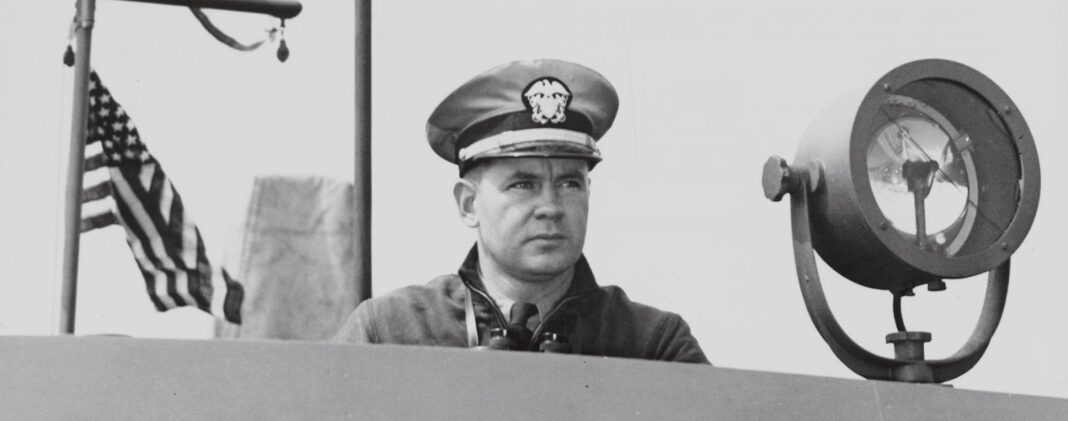

One of the most celebrated officers in U.S. Naval history, John Duncan Bulkeley’s name became synonymous with courage, unorthodox thinking, and uncompromising dedication to service. He gained particular fame during World War II, but his military career is more than just a few high-profile operations; it is an example of how honesty, boldness, and determination forge a true leader. You can also find out about the history of the Watts Rebellion. Read more at layes.
Biography
John Duncan Bulkeley was born on August 19, 1911, in New York. He showed an early interest in naval affairs and graduated from the U.S. Naval Academy in Annapolis in 1933. However, the timing for launching his career was unfortunate—the country was in the throes of the Great Depression. Due to budget cuts, many young officers were left without assignments. Bulkeley had to wait several months before receiving his first posting. Despite these difficulties, John did not lose heart. Bulkeley began his service on various warships, including the battleship USS Arkansas and other vessels. He quickly established himself as an officer capable of initiative, precise planning, and unconventional solutions. He showed a particular interest in a new type of weapon: motor torpedo boats (PT boats), which were considered promising but risky means of warfare. In his early years of service, he actively mastered naval technology, participated in training, and proved himself to be a capable, self-starting officer.

The Philippine Exploits
When World War II began, Bulkeley already had experience serving on several combat ships. He was transferred to the Pacific Fleet and given command of a squadron of Motor Torpedo Boats—small, fast, but highly vulnerable vessels that operated close to shore. Bulkeley led the PT-41 squadron, which was based in the Philippines. Following the Japanese attack on Pearl Harbor in December 1941, American forces in the Philippines were in an extremely difficult position. Bulkeley and his crew operated deep behind enemy lines, carrying out risky attacks on Japanese ships, transports, and positions. His boats worked to the limit of possibility—worn out and with minimal resources—yet under Bulkeley’s command, they inflicted significant damage on the enemy.
The most famous operation was the evacuation of General Douglas MacArthur and his family from Corregidor Island in March 1942. By order of President Roosevelt, MacArthur needed to be rescued to maintain command integrity on the Pacific front. Bulkeley took on the mission, knowing the Japanese controlled all approaches. Over several days, under fire and in stormy weather, aboard the PT-41 torpedo boat, he delivered the General, his family, and his staff to Mindanao, and from there, onward to Australia. MacArthur, deeply impressed by Bulkeley’s courage, later declared, “I shall return”—a phrase that became a symbol of American strategy in the Pacific. For this operation, John Bulkeley was awarded the Medal of Honor—the highest U.S. military decoration. Other honors followed: the Navy Cross, the Silver Star, and the Legion of Merit.
After the Philippines, Bulkeley did not rest. In 1944, he participated in the Allied invasion of Normandy, commanding the destroyer USS Endicott. His ship repeatedly engaged German E-boats, and Bulkeley himself demonstrated the same fierce determination he had shown in the Pacific. In one engagement, he personally stood on the bridge, directing fire in close-quarters combat.

Life After World War II
After the war, John Bulkeley served in Korea and held several administrative and strategic positions in the Navy. In the 1960s, he became famous as an active crusader against smuggling and corruption in military ports. During that period, he led inspections that uncovered schemes involving the theft of fuel, weapons, and equipment. His methods were tough, sometimes even scandalous, but highly effective. One of the most vivid episodes was his fight against theft in the Port of New York. Bulkeley personally went on raids, inspected warehouses, and ordered the arrest of suspects. He earned a reputation as a “tough but honest admiral,” for which he was simultaneously respected and feared.
Bulkeley remained in active service until 1988—a career spanning over 50 years. He became one of the last naval officers who began serving before World War II and witnessed the transformation of U.S. military power.
John Bulkeley passed away on April 6, 1996, at the age of 84. He was buried with full military honors at Arlington National Cemetery. In tribute to his service, the U.S. Navy named an Arleigh Burke-class destroyer after him—the USS Bulkeley (DDG-84), which joined the fleet in 2001. Bulkeley is remembered by posterity not only as a war hero but also as an example of a leader who was not afraid to take responsibility, act decisively, and operate with integrity, even when it was unpopular.

Awards and Honors
Rear Admiral John Duncan Bulkeley was not only a brilliant officer but also one of the most decorated heroes in the American Navy. His awards attest to his exceptional courage, determination, and willingness to take risks in the line of duty. Over 50 years of service, he earned dozens of military decorations—from both the U.S. and its allies.
The highest military award of the United States, the Medal of Honor, was awarded to Bulkeley for his heroism in the Philippines campaign in 1942, specifically for the daring evacuation of General Douglas MacArthur from Corregidor Island. He received the Navy Cross, the U.S. Navy’s second-highest honor, for heroism in combat conditions. Bulkeley was honored with this decoration for a series of bold operations against the Japanese fleet under circumstances of complete enemy superiority, where he repeatedly risked his life attacking enemy ships and convoys from small boats.
Bulkeley was awarded the Silver Star for personal bravery during naval engagements. The Silver Star is given for “gallantry in action against an enemy of the United States” and is the third-highest U.S. combat decoration. In a battle where Bulkeley commanded the destroyer USS Endicott, his ship engaged in close-quarters combat with two German E-boats—and emerged victorious. Bulkeley received the Legion of Merit multiple times for exceptional leadership and strategic initiative in both combat operations and administrative service. It recognizes not only bravery but also command effectiveness, reform efforts, and devoted loyalty. Bulkeley was wounded in the course of combat, earning the Purple Heart—an award given to all service members wounded or killed in action.

For cooperation with allies and participation in international operations, John Bulkeley was also recognized by foreign nations, including:
- The Legion of Honor (France)—for his role in the Normandy landings and the liberation of France.
- Distinguished Service Star (Philippines)—for the defense of the country in the first months of World War II.
- Campaign Medals—for participation in combat campaigns in the Pacific, Europe, and Korea.
His combat journey formed the basis of the book and film “They Were Expendable” (1945), where his character was portrayed by actor Robert Montgomery. Although the film contains artistic generalizations, it captured the main idea—the determination, courage, and ability to act in seemingly hopeless situations. Bulkeley himself was not enthusiastic about the glamorization of war but agreed with the core message: even the smallest forces can mount a resistance.
Also, find out about the “king of patents”—how the theoretical inventor Jerome Lemelson earned his living.